
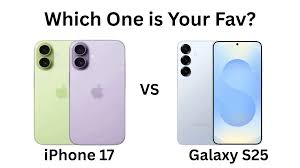
In the highly competitive flagship smartphone segment, the R14,799 (estimated, based on $799 USD) battleground is where many South African consumers, focused keenly on affordability, make their choice. Apple’s iPhone 17 enters the fray, finally offering long-requested features like the 120Hz ProMotion display. Its competitor, the Samsung Galaxy S25, is praised as the compact champion, excelling in battery efficiency and robust AI integration.
This comparison, tailored for the South African consumer who, according to market data, tends to favour Android devices due to their affordability and customisation options, breaks down where these two R14,799 devices truly shine.
Key Specifications: iPhone 17 vs. Galaxy S25 (Base Models)
The table below outlines the core hardware specifications. Note that for the same starting price (estimated at R14,799), the iPhone 17 offers double the base storage.
| Feature | Apple iPhone 17 | Samsung Galaxy S25 |
| Starting Price (USD/Estimated ZAR) | $799 / R14,799 | $799 / R14,799 |
| Base Storage/RAM | 8 GB RAM, 256 GB storage | 12 GB RAM, 128 GB storage |
| Display Size & Type | 6.3″ OLED, 120Hz ProMotion | 6.2″ AMOLED, 120Hz refresh rate |
| Peak Brightness | 3,000 nits | 2,600 nits |
| CPU | Apple A19 | Snapdragon 8 Elite for Galaxy |
| Rear Camera System | Dual: 48MP wide, 48MP ultrawide | Triple: 50MP wide, 12MP ultrawide, 10MP 3x telephoto |
| Wired Charging Speed | 40W (or 35W) | 25W |
| Data Port Speed | USB 2.0 (480Mbps) | USB 3.2 |
| Dimensions (mm) | 149.6 x 71.5 x 7.95 mm | 146.9 x 70.5 x 7.25 mm |
Design, Display, and Durability: Compact King vs. Pro Screen
The Galaxy S25 maintains its status as the most compact mainstream flagship. It is notably lighter (162g) and slimmer (7.25mm) compared to the iPhone 17, which measures 7.95mm thick and weighs 177g. Samsung employs an aluminium frame and Gorilla Glass Victus 2, whereas the iPhone 17 features an aluminium frame with Ceramic Shield 2 on the front and reinforced glass on the back.
Despite the focus on durable materials like “Gorilla Armor 2” and aluminium frames, some users of the base Galaxy S25 report micro scratches from everyday use and damage to the frame after minor drops, especially when used without a protective case. Experts strongly suggest using a case and screen protector regardless of the materials used, noting that “Glass is glass, and glass breaks”.
Display technology is where the iPhone 17 closes a significant gap. It adopts the ProMotion OLED display with a 1–120Hz variable refresh rate and the always-on display feature, which was previously restricted to Pro models. The iPhone 17’s screen is also larger (6.3 inches vs 6.2 inches on the S25) and significantly brighter, peaking at 3,000 nits (tested at 2672 nits) compared to the S25’s peak of 2,600 nits (tested at 2394 nits). The iPhone 17 benefits from a seven-layer anti-reflective coating, improving outdoor visibility. Conversely, the Galaxy S25 is preferable for dark environments due to its ability to achieve an extremely low minimum brightness.
Performance and Value: A19 vs. Snapdragon
Both flagships utilize powerful 3nm processors. The analysis reveals a nuanced performance split:
| Benchmark Category | Apple iPhone 17 (A19) | Samsung Galaxy S25 (Snapdragon 8 Elite) |
| Geekbench 6 Single-Core | 3527 (or 3701) | 3031 (or 2916) |
| Geekbench 6 Multi-Core | 8798 (or 9460) | 9626 (or 9886) |
| 3DMark Extreme High Score (Peak GPU) | 5172 | 5959 |
| 3DMark Extreme Low Score (Stability) | 3295 | 2500 |
The iPhone 17 leads in single-core performance, which is typically sufficient for most daily tasks. However, the Galaxy S25 pulls significantly ahead in multi-core scores, suggesting more raw throughput for multitasking and complex programs like gaming.
While the S25 achieved a higher peak GPU score, the iPhone 17 proved more stable under prolonged intense workloads, indicating better heat management and consistent performance.
Value Advantage: The iPhone 17 delivers better base value by offering 256 GB of storage for $799, whereas the S25 only includes 128 GB at the same price. However, the Galaxy S25 counters with 12 GB of RAM compared to the iPhone’s 8 GB.
Camera Capability: Versatility vs. Low Light
The camera comparison highlights the S25’s hardware versatility versus the iPhone’s improved sensor quality and low-light consistency.
The Galaxy S25 features a triple-camera system (50 MP main, 12 MP ultrawide, 10 MP 3x optical telephoto), making it more versatile for zoom shots. The S25 excels at 5x zoom shots by leveraging its dedicated telephoto camera, while the iPhone 17 suffers a drop in sharpness at this range.
The iPhone 17 boasts a substantial upgrade to a 48 MP ultrawide sensor (up from 12 MP), and its dual-camera setup provides “optical” zoom quality at 0.5x, 1x, 2x, and 4x. In overall testing, the iPhone 17 scored slightly higher (150 vs 147) due to its main and ultrawide camera performance. Critically, the iPhone offers a clear advantage in low light performance and generally achieves a more balanced colour profile. The new 18 MP front camera uses a unique square sensor that allows for consistent framing regardless of phone orientation, appealing greatly to selfie enthusiasts.
| Camera Score Metric | Apple iPhone 17 | Samsung Galaxy S25 |
| Overall Camera Score | 150 | 147 |
| Photo Score | 156 | 151 |
| Video Score | 145 | 142 |
| Photo Zoom Score | 21 | 23 |
| Front Camera Resolution | 18 MP | 12 MP |
Battery Life and Charging: Endurance vs. Speed
Battery life remains a distinct advantage for Samsung. The Galaxy S25 (4,000 mAh) vastly outlasted the iPhone 17 (3,692 mAh) in tests, particularly excelling in gaming endurance.
| Battery Metric | Apple iPhone 17 (3,692 mAh) | Samsung Galaxy S25 (4,000 mAh) |
| Overall Battery Life (Hours:Minutes) | 12:47 | 15:43 |
| Gaming Endurance (Hours:Minutes) | 9:12 | 12:20 |
| Wired Charging (30 minutes) | 71% | 57% |
The iPhone 17 takes a clear victory in charging speed, supporting 40W (or 35W) wired charging compared to the S25’s 25W. The iPhone also supports 25W MagSafe wireless charging, a feature the Galaxy S25 lacks.
Software and the AI Divide (Android vs. iOS)
For the South African market, which sees immense popularity for Android (with 83.7% of one sample group using it), the choice is often simplified by the operating system. Android (used by the S25) is an open-source platform known for its extensive customization features, availability across a wide range of price segments, and having a larger global user base. iOS (used by the iPhone 17) is a closed ecosystem that prioritises consistency, security, and optimised performance.
AI Power: The Galaxy S25 ships with Android 16-based One UI 7/8, featuring the fully integrated Galaxy AI suite, which is currently considered more polished and advanced than Apple’s offering. Samsung promises seven years of software updates. The iPhone 17 runs iOS 26, introducing the Liquid Glass interface, but many advanced Apple Intelligence features like Siri 2.0 are delayed or require accessory integration.
Conclusion for the South African Consumer
Both the iPhone 17 and Galaxy S25 are formidable $799/R14,799 flagships. The decision hinges on ecosystem preference and value priorities:
Choose the iPhone 17 if:
• You prioritise superior display brightness and better video quality.
• You value faster charging speed and the convenience of MagSafe.
• The 256 GB base storage is a major factor in value for money.
Choose the Samsung Galaxy S25 if:
• You require the most compact design and significantly longer battery endurance.
• You demand the versatility of a dedicated 3x optical telephoto camera.
• You prefer the customisation allowed by the open-source Android OS and require the most advanced AI features immediately












Leave a Reply