
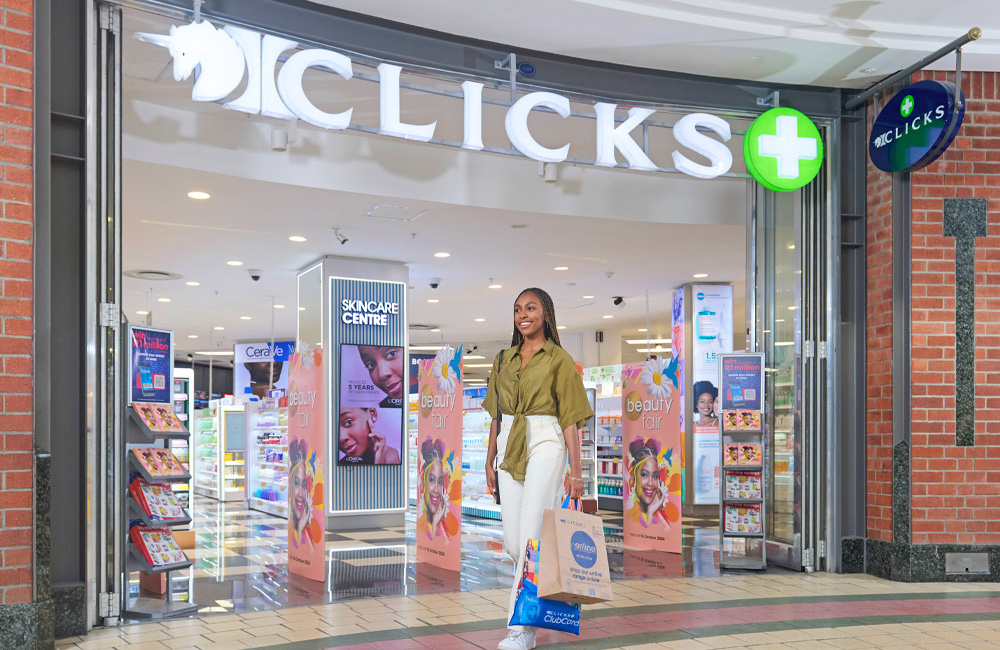
South African retail giant Clicks Group announced its interim financial results for the six months ending February 28, 2026, revealing a robust R24.9 billion in turnover despite severe market headwinds. While the health and beauty chain celebrated the milestone of opening its 1,000th store, a botched warehouse software rollout shaved R175 million off its retail turnover. Investors reacted cautiously to slowing growth forecasts, leading to a staggering R19.7 billion plunge in the company’s market value over a five-month period. How did a retailer achieving record store footprints and an 8.1% increase in headline earnings still face a massive stock selloff?
The Core Numbers: Revenue, Profit, and Dividends
Despite a highly constrained consumer environment, Clicks delivered a resilient financial performance. Group turnover increased by 7.4% to reach R24.9 billion, supported by an 8.6% surge in pharmacy sales.
The company successfully strengthened its retail pharmacy market share to 24.9%, up from 24.2% in the prior period. This growth helped drive a trading profit increase of 7.4% to R2.3 billion, maintaining a steady trading margin of 9.1%.
Shareholders also received positive news regarding direct returns. Diluted headline earnings per share (HEPS) grew by 8.1% to 653 cents. On the back of these earnings, the board declared an interim dividend of 258 cents per share, representing an 8.4% increase from the previous year.
The group proved to be highly cash-generative, producing R1.9 billion in cash from operations. Over the six-month period, Clicks returned R2.3 billion to shareholders through dividend payments and an aggressive share buyback program.
The Cost of Disruption: Warehouse Software Delays
However, the impressive top-line growth was hampered by a costly internal disruption. The implementation of a new warehouse management system (WMS) at the Clicks distribution centre in Cape Town experienced severe delays.
This software rollout issue severely reduced product availability in Western Cape and Eastern Cape stores. The timing could not have been worse, as the stock shortages hit during the critical and highly profitable festive season.
Management estimates that these system delays reduced retail turnover by approximately R175 million, equating to 0.9% of total retail sales. Product availability only stabilized and returned to targeted levels by the end of February 2026.
Market Reaction: Why the Share Price Plunged
Despite the solid dividend hike and revenue growth, the stock market severely punished the retailer. On January 2, 2026, Clicks shares traded at R332.34, giving the company a massive market capitalization of R77.7 billion.
By late May 2026, the share price had plummeted to R248.11. This steep drop erased approximately R19.7 billion in market value in just five months.
Market analysts suggest this selloff is due to a combination of aggressive competitor discounting from rivals like Dis-Chem and a realization that Clicks’ historically high valuation may no longer be justified. Analysts argue the stock is reverting to a more realistic price-to-earnings ratio after years of trading at a premium.
Proprietary Insight: Operational Growth vs. Market Reality
To understand the current investment landscape regarding Clicks, we must look at the disconnect between its operational health and investor sentiment. Below is a custom analysis comparing actual business growth against market perception.
- Turnover Growth: +7.4% (Strong operational sales execution)
- Dividend Payout Growth: +8.4% (High shareholder cash returns)
- Retail Margin: +70 basis points (Improved profitability via private label brands)
- Market Capitalization: -25.3% (R19.7 billion wiped out since January)
- Full-Year Profit Forecast: +4% to +9% (Below historical double-digit analyst expectations)
Actionable Insight for Investors: The data reveals that Clicks is not fundamentally broken; rather, it is a mature, cash-generating business transitioning from a “high-growth stock” to a “value and dividend stock.” The 70 basis point retail margin expansion—driven by private label goods—shows excellent cost control that long-term value investors often seek.
Retail Expansion and The Power of Loyalty
Operationally, the company continues its aggressive physical expansion. Clicks reached a historic milestone during this period by opening its 1,000th store, bringing the total national footprint to 1,003 stores and 795 pharmacies.
A major pillar of this ongoing success is the Clicks ClubCard loyalty program. Active membership grew by a staggering 800,000 users, reaching a total of 12.9 million members.
This loyalty base is incredibly lucrative, contributing 83.7% of all sales within the retail stores. In return, loyal shoppers received R527 million in cashback rewards over the six months, helping to maintain customer retention amid aggressive competitor discounting.
Sustainability and Distribution: The UPD Edge
Beyond retail, the group’s pharmaceutical wholesaler, UPD, delivered strong results with distribution turnover growing by 13%. This was primarily driven by a massive 31.1% increase in revenue from preferred supplier bulk contracts.
Crucially, UPD has turned sustainability into a major competitive advantage. The distributor doubled its fleet of zero-emission, pharma-compliant electric delivery vehicles to 85.
Because of this early investment in solar energy, battery storage, and electric transport, 86% of wholesale deliveries are no longer exposed to volatile fuel costs. As national fuel prices continue to surge and drive inflation up to 4%, this operational efficiency protects the company’s bottom line.
What to Expect Next: Full-Year Outlook
Looking ahead, Clicks management expects the consumer environment to remain under significant pressure. Rising fuel prices and inflation will continue to heavily constrain household spending throughout the second half of the year.
Despite these macroeconomic hurdles, the group is committing R1.3 billion to capital expenditure for the 2026 financial year. This massive investment will fund the opening of 40 to 50 new stores and an equal number of new pharmacies.
Furthermore, Clicks plans to pilot 10 new differentiated concept stores in the second half of the year. Directors currently forecast that the group’s full-year diluted HEPS will increase by a modest 4% to 9% compared to the 2025 financial year, assuming no major geopolitical shocks disrupt the South African economy.













Leave a Reply