
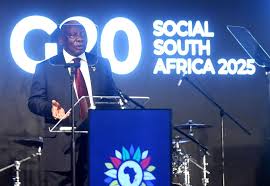
The G20 Summit held in Johannesburg, South Africa, achieved consensus and adopted a landmark Leaders’ Declaration at the beginning of the meeting on 22 November 2025, marking a significant diplomatic moment for the African host nation. This outcome was secured despite a complete boycott of the summit by the United States and intense diplomatic tension. South African President Cyril Ramaphosa’s strategy involved the “unorthodox decision” to get the declaration adopted at the start, rather than the end of the meeting, a move some sources suggested was designed to pre-empt any potential backtracking on commitments.
The adopted declaration meets most of South Africa’s priorities, although some members might have preferred stronger language on areas like debt sustainability, gender equality, and climate issues. Speaking on the diplomatic tensions, Presidency spokesperson Vincent Magwenya affirmed that South Africa would not bend protocol to accommodate Washington’s attempts, stressing that “We are a sovereign country”. The US boycott, ordered by President Donald Trump, was attributed to his rejection of South Africa’s agenda, which focused on promoting solidarity, helping developing nations adapt to climate change, and cutting excessive debt costs.
Consensus on Core Global Challenges
The declaration outlines broad agreement on several crucial matters primarily related to the global economy and development, framing everything under South Africa’s theme of “Solidarity, Equality, Sustainability”.
One of the most notable features of the document was its condemnation of terrorism, which it rejects in all its forms and manifestations. Leaders reaffirmed their commitment to acting in accordance with international law, including the UN Charter, and condemned all attacks against infrastructure and civilians. The declaration commits to working toward a just and lasting peace in several conflict zones globally, including Sudan, the Democratic Republic of Congo, the Occupied Palestinian Territory, and Ukraine, emphasizing that sustainability and prosperity depend on peace.
The language used in the adopted declaration, stressing the seriousness of climate change and ambitious targets for renewable energy, stood in stark contrast to the previous anti-climate policy stances of the US administration.
Tackling Debt and Inequality
South Africa successfully used the G20 platform to amplify issues critical to Africa and the Global South, especially debt and inequality, which experts noted could become the country’s lasting G20 legacy.
On Debt Sustainability, leaders recognized that high debt levels are a major obstacle to inclusive growth in many developing economies, restricting their ability to invest in essential areas like healthcare and education. It was noted with concern that interest payments on total external public debt have more than doubled over the past decade for low-income countries. Leaders reiterated their commitment to strengthening the implementation of the G20 Common Framework for debt treatments in a timely and coordinated manner, while also calling for enhanced debt transparency from all stakeholders, including private creditors.
On Global Inequality, the South African Presidency commissioned a major report by the Extraordinary Committee of Independent Experts on Global Inequality, led by Nobel Laureate Joseph E. Stiglitz, as a flagship achievement. This report found that globally, between 2000 and 2024, the wealthiest 1% captured 41% of all new wealth, severely outpacing the bottom half of humanity, who captured just 1%. The Committee proposed the immediate establishment of an International Panel on Inequality (IPI) to provide authoritative, technical assessments and analyses of inequality trends, similar to the Intergovernmental Panel on Climate Change (IPCC).
Beyond Diplomacy: Practical Initiatives
The Summit also advanced several practical voluntary initiatives focused on Africa’s priorities. These included strengthening disaster resilience and response, and mobilizing finance for a just energy transition, especially noting that over 600 million Africans lack access to electricity. The summit welcomed the launch of the AI for Africa Initiative as a voluntary platform for multilateral cooperation to promote access to computing power, infrastructure, and training for Africa-centric sovereign AI capabilities. Furthermore, the G20 Critical Minerals Framework was welcomed as a voluntary blueprint to ensure that critical minerals become a driver of prosperity and sustainable development for producer countries.
The G20 Leaders welcomed the African Union as a full member in its second year in the group, ensuring that Africa’s voice continues to be amplified in international fora.
Despite the US boycott, the consensus achieved and the adoption of the declaration proved that the G20 Summit would proceed and not be derailed by diplomatic tension. Following the Summit, the G20 presidency will be handed over to the United States for the 2026 meeting.
The successful early adoption of the G20 Leaders’ Declaration in Johannesburg, despite external diplomatic pressure, illustrates that global multilateral bodies, much like a robust ship navigating a storm, rely on internal coordination and shared direction to stay on course and deliver their mandate, even if one major partner chooses to remain in port.










Leave a Reply