

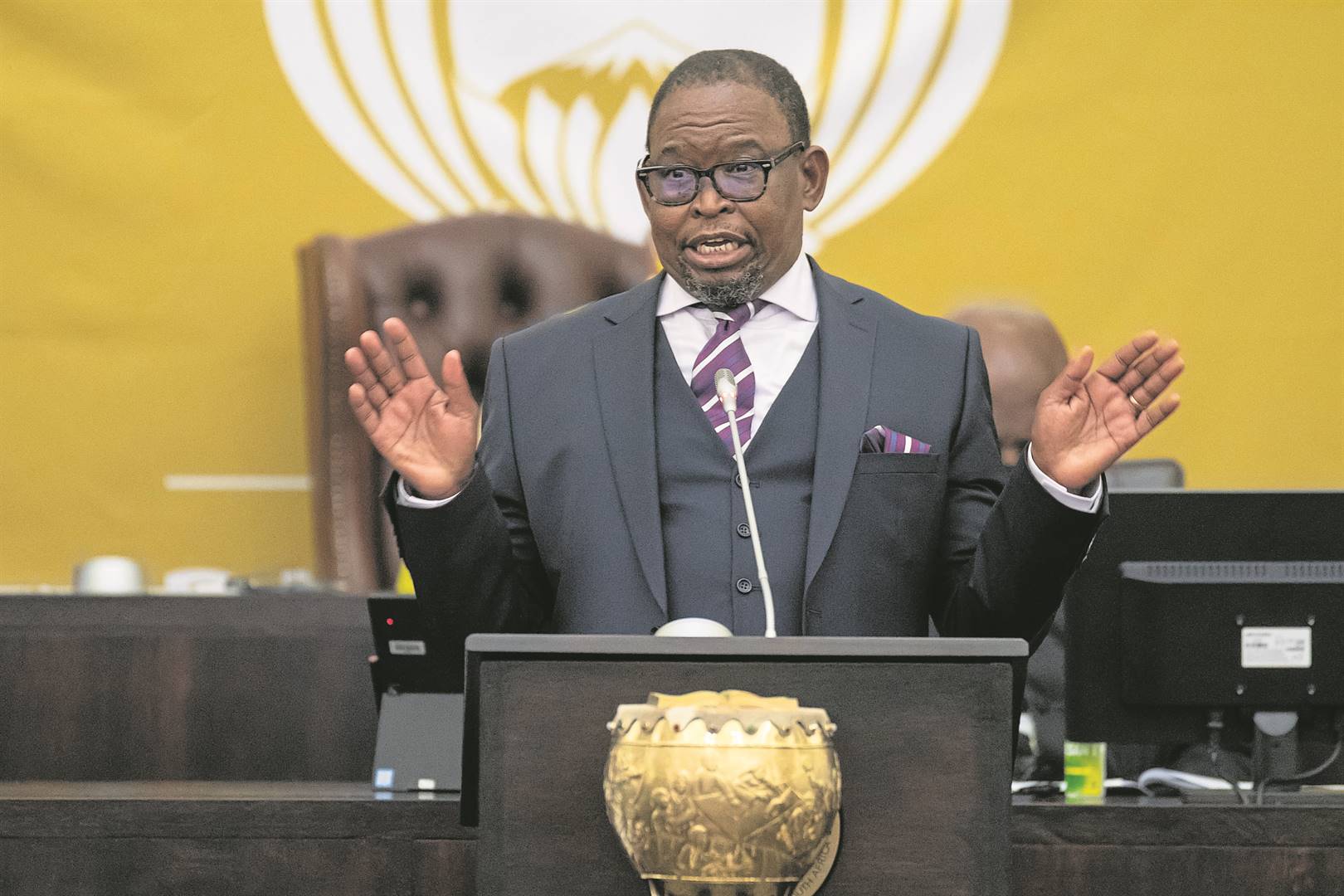
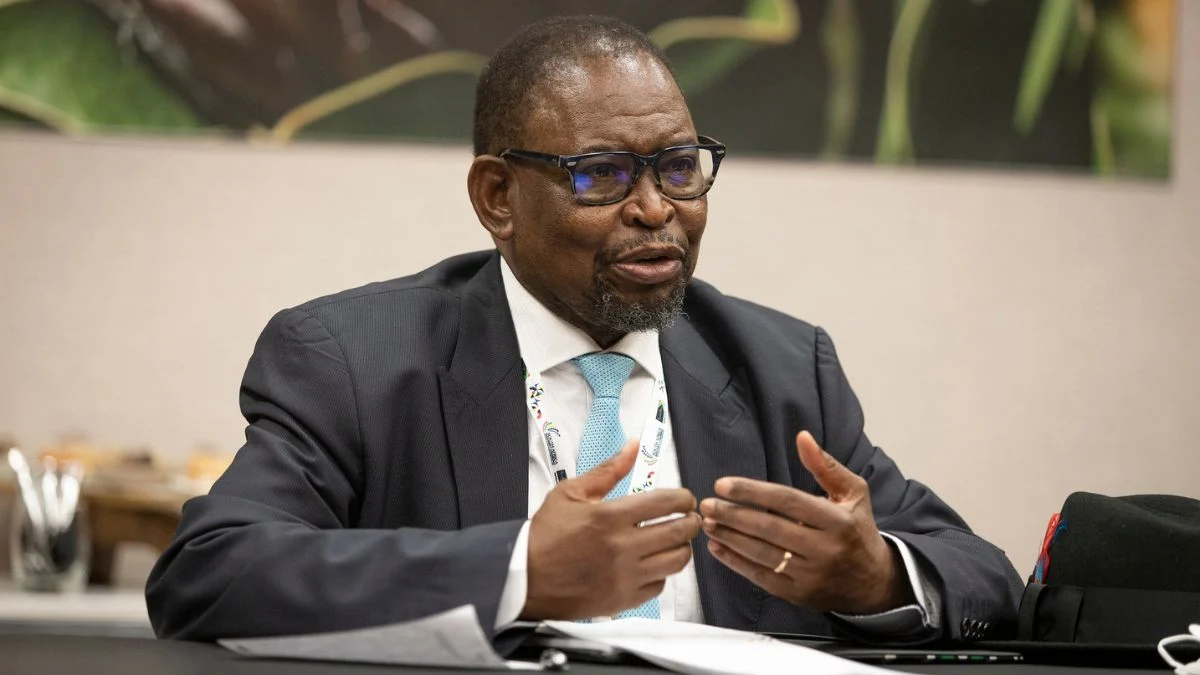
South African Finance Minister Enoch Godongwana has pulled no punches regarding state spending inefficiency, announcing drastic budget cuts and revealing he would immediately shut down the National Student Financial Aid Scheme (NSFAS) if political realities allowed.
Speaking at a Rand Merchant Bank “Think Budget” event following his presentation of the Medium-Term Budget Policy Statement (MTBPS), Godongwana unveiled a government strategy defined by “tough love” for state entities and a landmark shift in the country’s monetary policy.
The Financial Aid Scheme Godongwana Would Close “With His Eyes Closed”
Minister Godongwana revealed that the closure of NSFAS—a scheme established in 1996 to provide financial support to undergraduate students—was seriously “debated for an hour” by the National Treasury.
The Finance Minister expressed severe frustration with the functioning of NSFAS, which operates with an annual budget of R50 billion and holds a historical debt of R45 billion.
The Minister’s core argument for closure rests on two key pillars:
1. Inefficient Conduit: Godongwana views NSFAS as an unnecessary intermediary. He noted that the scheme takes money from the Department of Higher Education and transfers it to universities, arguing that the funds could be transferred directly to institutions.
2. Dysfunction and Outsourcing: The Minister highlighted that the institution is so dysfunctional that it has outsourced the work it was created to do, employing four service providers for its core functions. This outsourcing, he suggested, justifies its closure.
Adding to the controversy, Godongwana pointed out that the NSFAS CEO’s annual earnings are around R4 million, which is “more than the President himself”.
Despite his eagerness to dissolve the agency, which he said he would do “with my eyes closed,” Godongwana acknowledged that “vested interests” and the certainty of widespread student upheaval prevent the move. He warned that if the closure were announced, “there would be protests on campuses”.
The institution has faced heavy criticism, including reports from the Auditor-General of South Africa (AGSA) revealing nearly R60 billion in irregular expenditure. Furthermore, the Special Investigating Unit (SIU) found that over 40,000 students across 76 higher education institutions may have been funded incorrectly, potentially misallocating more than R5 billion.
Tough Love: A New Fiscal Era for State-Owned Enterprises (SOEs)
The government is committed to maintaining a “tough love” approach toward State-Owned Enterprises (SOEs) that have failed to meet legal requirements for sustainable profitability and prudent use of public resources. The National Treasury warned that progress on turnaround plans has been mixed, forcing the government to consider “difficult decisions” such as closures, mergers, or the withdrawal of financial support.
South African Post Office (SAPO) Cut Off
The financial distress of the South African Post Office (SAPO) was a central concern. SAPO was placed in business rescue in July 2023 and faces the serious threat of liquidation.
• No New Bailout: Minister Godongwana confirmed that SAPO will not receive any further new government bailouts, even if it manages to exit business rescue. The Post Office’s business rescue practitioners had requested R3.8 billion to complete the rescue process, settle creditor accounts, and recapitalise the entity.
• Restructuring and Social Mandate: Since entering business rescue, SAPO has closed 354 branches and shed over 4,875 employees. Despite having a social mandate to serve all South Africans, particularly those in rural areas who rely on its services for grants and affordable banking, the government is not providing additional funding. Instead, the Department of Communications and Digital Technologies is exploring partly privatising SAPO to improve competitiveness.
Eskom and Transnet Receive Targeted Support, Not General Bailouts
Following R520 billion spent on SOE bailouts since 2008/09, the government is now limiting financial support.
• Eskom Debt Reduced: Although Eskom received a R254 billion debt relief package in 2023, the National Treasury has reduced the overall projected debt package by R24 billion, reflecting some improvement in the utility’s financial position. The final R70 billion debt takeover will be replaced with two advances totalling R50 billion. Eskom’s losses doubled to R55 billion in 2023/24, mainly due to high finance costs and poor operational performance.
• Transnet Debt Focus: Transnet continues to struggle, reporting a net loss of R7.3 billion in 2023/24. While the government guaranteed Transnet R47 billion in December 2023 to refinance maturing debt, the National Treasury stated it is now prioritizing direct support for critical infrastructure projects and actively avoiding debt relief or general balance sheet support.
Historic Monetary Policy Shift: SA Adopts New 3% Inflation Target
In a pivotal move for South Africa’s economic future, the government announced the reduction of the inflation target to 3%, accompanied by a tolerance band of 1 percentage point. This marks the first time in 25 years that the target has been changed.
Minister Godongwana stated that the new target aims to anchor inflation at permanently lower levels, which is expected to reduce the cost of living and borrowing costs for households, businesses, and the government.
The shift, which aligns South Africa’s monetary policy with international best practice and emerging market peers like Brazil, is anticipated to:
• Support higher long-term economic growth and job creation.
• Decrease inflation expectations and create space for permanently lower interest rates.
• Mitigate the depreciation of the Rand exchange rate, which is eroded by having a higher average inflation rate than trading partners.
While this move is celebrated for its long-term benefits, the MTBPS concedes that a lower inflation target could temporarily result in a lower nominal GDP and reduced revenue projections. However, the National Treasury believes the positive counteraction from reduced debt-service costs means the long-term benefits clearly outweigh these short-term concerns.
R6.7 Billion Saved as Inefficient Programmes Are Axed
Under the Targeted and Responsible Savings (TARS) initiative, the government is implementing medium-term savings of R6.7 billion by scaling down or closing low-priority and underperforming programs.
Minister Godongwana emphasized that eliminating waste and inefficiency is “non-negotiable”. The savings include identifying individuals who are defrauding the social grants system through double-dipping, and scaling down the public transport network grant, which has widely failed to meet its objective.
This systematic review aims to bolster efficiency, protect frontline services, and create fiscal space to increase spending on priorities such as growth-enhancing infrastructure.








Leave a Reply