
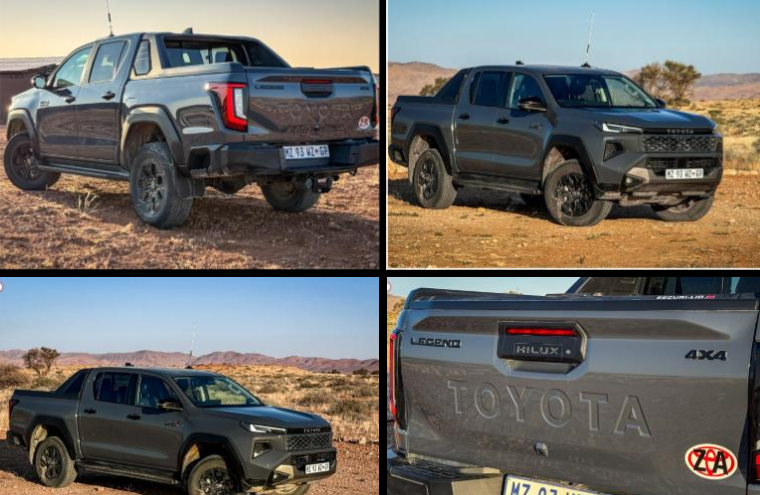
In mid-2026, Toyota launched the highly anticipated 9th-generation Toyota Hilux in South Africa and Namibia, directly challenging the dominant, tech-heavy Ford Ranger. Built locally at Toyota’s Prospecton plant in KwaZulu-Natal and exported to 44 countries, the new Hilux arrives with a 48V mild-hybrid system, drastically improved suspension, and a bold “Cyber-Sumo” design. While competitors have opted for entirely new platforms, Toyota has deliberately retained its proven ladder-frame chassis to prioritise commercial durability over urban luxury. This comprehensive analysis breaks down exactly how the new Hilux stacks up against the Ford Ranger, providing South African business owners and adventurers with the data needed to make an informed purchasing decision.
The Bakkie Battle: Why the 9th-Gen Hilux Matters in South Africa
The Toyota Hilux is deeply woven into the fabric of South Africa’s agricultural, mining, and fleet sectors, having served as the nation’s best-selling light commercial vehicle for decades. When engineering the 9th-generation model, Toyota faced a distinct choice: build a luxury leisure vehicle or refine a dependable workhorse.
Toyota chose the latter. The Japanese automaker explicitly focused on reliability and practicality, the two primary metrics demanded by commercial and agricultural buyers. Rather than reinventing the chassis, Toyota reinforced the existing structure, adding 36 new spot welds to the body and upgrading the suspension towers.
This conservative approach has drawn some criticism from urban buyers who view the update as a heavy facelift rather than an all-new vehicle. However, Toyota executives remain confident, noting that buyers operating in remote mining or farming applications prioritise a trusted 280-strong dealership network and guaranteed parts availability over polarising EV design trends.
Proprietary Data: Toyota Hilux 2.8 GD-6 vs. Ford Ranger V6
To understand how the new Hilux performs against its fiercest rival, we must look beyond the marketing brochures. Below is a custom comparative analysis based on recent independent mega-tests and technical specifications.
Performance and Utility Comparison Table
- Engine Output: The Ranger’s 3.0L V6 delivers a massive 184 kW and 600 Nm, easily outmuscling the Hilux’s 2.8L four-cylinder engine, which produces 150 kW and 500 Nm.
- Acceleration (0-100 km/h): The Ranger V6 completes the sprint in a tested 8.63 seconds, while the Hilux trails at 11.55 seconds.
- Real-World Fuel Efficiency: The Hilux strikes back with remarkable efficiency, achieving a tested 7.9 L/100 km on mixed roads, whereas the thirsty Ranger V6 consumed 13.2 L/100 km under similar conditions.
- Load Bay Practicality: In a critical metric for business owners, the Ranger offers a tub width of 1,217 mm between the wheel arches. The Hilux measures only 1,105 mm. This means the Ranger can accommodate a standard Euro or Aussie pallet flat in the load bin, while the Hilux cannot, severely impacting specific freight applications.
- Towing and Payload: Both vehicles boast a maximum braked towing capacity of 3,500 kg. However, the Ranger is roughly 200 kg heavier than the Hilux. When towing at the maximum limit, the Hilux actually offers roughly 100 kg more usable payload capacity in the cabin and load bin than the Ford.
Under the Skin: Mechanical and Technological Leaps
Suspension Upgrades: Conquering the Corrugations
The most profound improvements to the 9th-generation Hilux are hidden within its suspension geometry. Historically, unladen Hilux models suffered from a harsh, bouncy ride on rough surfaces.
To rectify this, Toyota completely redesigned the shock absorbers, upscaling them to larger monotube units filled with a highly advanced thermal oil. On punishing corrugated gravel roads, traditional shock absorbers can heat up to 600°C, causing the oil to foam and completely lose compression damping. The new Hilux shocks manage heat far more efficiently, running at an average of 200°C under identical stress, ensuring the suspension works optimally without fading.
The 48V Mild-Hybrid System Explained
In a first for the Hilux, Legend models are equipped with a 48V mild-hybrid (MHEV) powertrain. This is not a traditional hybrid system that can drive the vehicle on pure electric power. Instead, a compact 7.6 kg lithium-ion battery housed under the rear seats powers a motor-generator.
This system injects an additional 12 kW of power and 65 Nm of torque into the driveline to smooth out acceleration and fill turbo lag. Furthermore, it allows Toyota to lower the engine’s idle speed from 720 rpm to 600 rpm, vastly improving low-speed crawling and refinement in off-road environments.
Interior Refinements and Technology Bugs
The interior of the Hilux has moved towards a more premium, horizontal “Cyber-Sumo” design language, drawing heavy inspiration from the Land Cruiser Prado.
Key cabin updates include:
- A 12.3-inch digital instrument cluster and matching 12.3-inch infotainment screen on higher trims.
- Electronic Power Steering (EPS), which replaces the heavy hydraulic setup, offering lighter steering at low speeds and better feedback on the highway.
- Toyota Safety Sense 3 (TSS3), featuring true adaptive cruise control, active lane keep assist with steering intervention, and blind-spot monitoring.
While the technology is a massive leap forward, early testing reveals some connectivity frustrations. The new wireless Apple CarPlay and Android Auto systems have proven buggy in real-world scenarios, frequently dropping connection or requiring users to resort to wired cables.
Real-World Case Study: The Namibian Gravel Test
To prove the efficacy of the new chassis, automotive journalists recently subjected the 9th-generation Hilux to a brutal 1,000 km test drive through the harsh deserts and corrugated roads of Namibia.
The results highlight Toyota’s engineering priorities. Driving at speeds of 110 km/h to 120 km/h in Four-High (4H), the notorious “tail kick-out” over mid-corner bumps a hallmark of previous Hilux generations was completely absent. The vehicle remained remarkably stable, with the EPS system and new damper oil preventing the suspension from washing out. Over the entire 1,000 km gravel route, the 2.8 GD-6 engine returned an impressive 11.6 L/100 km, a highly respectable figure given the constant 4H engagement and heavy rolling resistance.
The Verdict: Which Bakkie Makes Business Sense?
Choosing between the Toyota Hilux and the Ford Ranger ultimately comes down to your primary use case.
Choose the Ford Ranger if: You are a lifestyle buyer who prioritises SUV-like comfort, immense V6 overtaking power, and superior rear-seat passenger legroom. The Ranger is the undisputed king of leisure and on-road dynamics, offering better wheel articulation for technical rock crawling.
Choose the Toyota Hilux if: Your bakkie is an income-generating asset. The Hilux remains the superior commercial workhorse. Its fuel efficiency is substantially better than the Ranger V6, its reliability is legendary, and its payload capabilities when heavily laden are less compromised by vehicle kerb weight. For overlanders heading deep into the African continent, Toyota’s ubiquitous parts availability and dealership network make the Hilux the safer financial bet.
2026 Toyota Hilux Pricing in South Africa
Toyota has streamlined the local lineup into distinct trim levels: SRX, Raider, Raider X, and the flagship Legend. Note that while the 2.8L engines are available immediately, the highly popular 2.4L variants will follow in early 2027.
Current Double Cab Pricing:
- 2.8 GD-6 SRX AT 4×2: R658,500
- 2.8 GD-6 SRX AT 4×4: R746,100
- 2.8 GD-6 Raider X AT 4×4: R892,900
- 2.8 GD-6 Legend AT 4×2 (48V MHEV): R945,500
- 2.8 GD-6 Legend AT 4×4 (48V MHEV): R999,900
All models include a 3-year/100,000 km warranty and a 9-service/90,000 km service plan, with the 48V hybrid battery receiving an extended 8-year/160,000 km warranty.
The 9th-generation Toyota Hilux may not rewrite the rulebook on exterior design, but by focusing on suspension dynamics, robust commercial payload metrics, and hybrid-assisted efficiency, it remains the definitive business partner for the South African market.














Leave a Reply